Apr 3, 2006
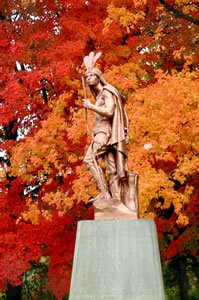
Chief Hopocan
Religious ceremonies were centered around a dedicated "big house." Dreams were considered very significant, so Lenape priests were divided into two classes: those who interpreted dreams and divined the future; and those dedicated to healing. The dead were buried in shallow graves, but method varied considerably: flexed, extended, individually, and sometimes groups. The Lenape believed in a afterlife, but without the Christian concept of heaven and hell - a source of considerable frustration for Moravian missionaries. Lenape were reluctant to tell their real name, and the use of
nicknames was very common. The real name of Captain Pipe, the head of the Delaware Wolf clan in 1775 was Konieschquanoheel "maker of daylight." His nickname, however, was Hopocan meaning "tobacco pipe"
- hence his historical name of Captain Pipe.
Hopocan (Tobacco Pipe) / Captain Pipe / Konieschguanokee / Komeschguanokee (Maker of Day) / Tahunquecoppi [fl. 1764 onwards; died 1794], Munsee/Delaware war chief, Wolf clan; "a sober, sensible Indian"; he attended a conference at the camp at Tuskerawas, October 13 to December 16, 1764; listed in the war losses of the trader Franks on August 19, 1766; succeeded Munsee/Delaware Chief Custaloga [Pakanke] in 1773; moved away from Delaware chief Netawatwees to the south shore of Lake Erie at Cayhoga in 1776; he was the leader of the pro-British Delaware faction, but signed the US Fort Pitt Treaty, September 17, 1778; he lived on the Upper Sandusky River in 1780, and gained control of the Delaware Council at Coshocton in the fall of that year; lived at the headwaters of the Mad River, spring 1781; Captain Pipe, Delaware chief, agreed to bring the Moravians to Detroit under his protection on October 21, 1781; he attended and spoke at councils with the Moravians and the British at Detroit, November 9 and December 8, 1781; with Buckongehelas he defeated the US Militia under the command of Captains Crawford and Williamson on the Sandusky River in June 1782, after the Gnadenhütten massacre; he signed the US Treaty of Fort McIntosh, January 21, 1785; he lived on the south shore of Lake Erie near the Maumee River in 1786; he signed US Treaty of Fort Harmar, January 9, 1789; he informed the Moravians in February, 1791 that they should leave the Huron River because it was unsafe; he attended a council at Niagara to discuss the US Indians, April 14, 1791; he met the
Five Nations in council at the Miami Rapids, August 17, 1792; Captain Pipe / Tahunquecoppi, Delaware Nation, signed the US Peace Treaty at the Miamis Rapids, September 29, 1817 (US 1837; Goddard 1978a: 223; Gray: 54, 56, 62; Kjellberg: 26, 29-30; Tanner 81, 83-84, 89-90; DCB vol. VI: 302; MPHSC vol. X: 527, 538-540, 543, 545, vol. XIII: 42-46, vol. XIX: 276, 374, 690, vol. XX: 66-67, 134, 680, vol. XXIV: 24, 179, 208, 468, 486, 492, vol. XXV: 690; PSWJ vol. V: 355, vol. XI: 435, 724, vol. XII: 1047-1048). 'While you, father are setting me on your enemy, much in the same manner as a hunter sets his dog on the game...I may, perchance, happen to look back to the place from whence you started me, and what shall I see? Perhaps I may see my father shaking hands with the long knives; yes, with these very people he now calls his enemies. I may then see him laugh at my folly for having obeyed his orders; and yet I am now risking my life at his command!' —Detroit, November 9, 1781.
Famous Chiefs
Native Name
Hopocan (Tobacco Pipe) or Konieschquanokee (Maker of Day)
White Name
Captain Pipe
Nation
Delaware
Some say Hopocan or Captain Pipe was born about 1725; others put his birth at 1740. A member of the Munsee or Wolf Clan of the Delaware people, he became Chief of that clan. He was probably born near the Susquehanna River in Pennsylvania. Most of the Pennsylvania Delaware had moved to Ohio by 1758. He is first mentioned historically in 1759 at Ft. Pitt. When Fredrick Christian Post was given permission by the Delaware to build a cabin on the Tuscarawas River at present Bolivar, Ohio, Pipe was given the job of marking out the land he was to receive. As one of the three clan chiefs of the Delaware Nation, Pipe had a lot of responsibilities. One of them was to work with the other chiefs to keep the people safe. He had to be a warrior, a negotiator and a good listener to his people. Captain Pipe fought in the French and Indian War and in Pontiac's War where in 1764 Pipe was captured and held prisoner at Ft. Pitt. Col. Henry Bouquet dictated peace terms to the Delaware instead of negotiating with them. Pipe found this very distasteful and it set his opinion of the Shawanock, or Long Knives, for the rest of his life.
In 1778 General Edward Hand of the American Colonial forces killed Captain Pipe's mother, brother and some of his children. Even so he was with Captain White Eyes and Killbuck in 1778 when they signed the first-ever treaty with the Continental Congress and Native people. The Ohio country was to be the Fourteenth State and only for Native people. The Delaware people became divided over which side of the American Revolution they should support. Captain Pipe became the leader of those who supported the British and moved his people to the Sandusky River.
In 1782 Captain Pipe and his people captured Col. Crawford who was held responsible for the murders of Chief Logan's family. Col. Crawford and his men were executed in the same fashion as Logan's family. He participated in many battles and led his people in what he believed was right. Some believe he died in 1794, but proof exists that he was at the Battle of Fallen Timbers, but not at the Greenville Treaty signing. In 1795 a French trader named Jerome built a cabin at what is present Jeromesville in Ashland County, Ohio, on the Jerome Fork of the Mohican River. In 1808-09 early white settlers to the area found Delaware people living at the old Mohican village of Johnstown across the river from Jerome near which was located the home of Old Captain Pipe. Many stories of the settlers and the remaining Delaware talk of Old Captain Pipe living there until 1812. In the spring of 1812 Old Captain Pipe and his people quietly disappear and were never again seen near Jeromesville.
Captain Pipe had a son also named Captain Pipe who signed many treaties and moved with the Delaware people to Kansas. He had no children.
Resources
Captain Pipe http://www.ohiohistorycentral.org/ohc/history/h_indian/people/captpipe.shtml
Captain Pipe, 1725-1794 (H for Hopacan) http://www.alexanderstreet2.com/EENALive/bios/A6949BIO.html


Never judge a man unless you've walked a mile in his moccassins. King George W. Bush i spit this in your eye.

"Beginning probably in the 1730s and spreading South, North, and East from the Ohio Valley was an inter-tribal discussion on what encroachment by Europeans meant for Indians. The most influential philosophers of this movement were prophets of a new world order. The most famous of these was Neolin, the Delaware Prophet, who preached that the Indians had collectively sinned by adopting “White people’s ways and nature.” He told a Descartes-style story of sitting alone by the fire, “musing and greatly concerned about the evil ways he saw prevailing among the Indians” when a man appeared who taught him a pure religion that would restore all Indians to a right relationship with the cosmos. Thousands of Indians, seeking wisdom and ready to act, followed Neolin and other prophets in ritual vomiting, witch-hunts, and rejection of European tools and alcohol. Some followers, such as the Ottawa warrior Pontiac, resorted to war in order to jump-start the new Indian renewal.
The impact of colonial expansion, land dispossession, and the trading of goods, specifically
alchohol, was obviously destructive to the Native americans. Although sometimes the Delaware turned to the missions for help and shelter, there was another phenomenon that attempted to deal with colonial influence, and that was prophetic movements. "Prophets and prophecy are an integral part of Native American religions."A prophet or messiah traditionally arises to give hope and direction in times of adversity" (Champagne 675) In the late eighteenth century, a time when the Delaware were threatened by British domination, and continual colonial expansion, several prophets arose to deal with these issues. One is referred to as the militant prophet, Neolin (enlightened one). Neolin had a dream in which the Great Spirit told him that because the Indians gave up their native traditions and accepted goods from the Europeans, the path to heaven was blocked (Champagne 1043) He advocated a tribal coalition that would push back the encroaching British. It is believed that Pontiac an Ottawa chief, was influenced by the Delaware Prophet and subsequently battled the British.
During 1762 there were widespread crop failures and epidemic. At this moment, a native prophet, Neolin (Enlightened), arose among the Delaware villages near the Ohio River. His message - return to traditional ways and reject the white man's trade goods, especially rum. His teachings not only won wide acceptance among the Delaware, but spread to other tribes. To the Kickapoo, nothing could have made more sense, and they became some of his strongest supporters.
Delaware Prophet (dĕl'əwâr, –wər), fl. 18th cent., Native American leader. His real name is not
known. He began preaching (c.1762) among the Delaware of the Muskingum valley in Ohio. He spoke against intertribal war, drunkenness, polygamy, and the use of magic, and he promised his hearers that if they would but heed his words the Native Americans would be strong again and able to resist the whites. He prepared symbolic charts of his message on deerskin and left them in various villages to help his converts teach others. The religious fervor spread rapidly and is said to have been an inspiration to Pontiac. After the collapse of Pontiac's Rebellion (1763–66) the following of the Delaware Prophet waned and was largely superseded by that of the Munsee Prophet, who was in turn succeeded by the Shawnee Prophet.
The British made some attempt to calm the increasingly explosive situation, and in 1762 sent
Lieutenant Thomas Hutchins to Ouiatenon to speak to the Wabash tribes. In the course of the meeting, a Mascouten chief arose to ask Hutchins for supplies for his people who were ill and starving. Hutchins, of course, had nothing to offer except promises. At the same time, a prophet arose among the Delaware adding a religious element to the crisis. Neolin, the Delaware Prophet, taught a rejection of all European trade goods and a return to traditional Native American values. While Neolin did not actually advocate violence, his teachings were seized upon by Pontiac, the Ottawa chief at Detroit and a bitter enemy of the British. Throughout the winter of 1762-63, Pontiac organized a secret uprising which, when it struck the following May, captured six of the nine British forts west of the Appalachian Mountains.
1. Prophets and Messiahs
Movements of nativism (the assertion of traditional values in the face of foreign encroachment) and revitalization (the revival of traditional culture, often involving explicit rejection of European
civilization) have arisen, led by Native American prophets who claimed to have received revelation from the aboriginal deities, often in dreams and visions. These prophets have frequently shown evidence of Christian influence in their moral codes, their missionary zeal, and their concern for personal redemption and social improvement. Sometimes their teachings have led to military advances against European invaders. For example, in the early 1760s the Delaware prophet Neolin helped inspire the rebellion of Ottawa warrior Pontiac against the British. Similarly, the preaching of Shawnee prophet Tenskwatawa bolstered the military efforts of his brother Tecumseh against the United States Army between 1808 and 1813. The revivals of preachers such as the Iroquois Handsome Lake in 1799 and the Salish John Slocum in 1882 spawned new religions—part native, part Christian—that have endured in their respective communities to the present day.
One of the most prolonged Native American uprisings took place in the Southwest under the leadership of a Tewa medicine man named Pop, who in 1680 led the various indigenous peoples of present-day New Mexico in a rebellion against Spanish missionaries and conquistadors. The Native Americans drove the Spanish out and kept them at bay for more than a decade. During the Spanish reconquest, the Hopi burned one of their own villages and killed its converted inhabitants rather than allow the reestablishment of Christianity as the official religion. To this day the Hopi pueblos, or villages, resist the influence of Christian religions, although some Hopi have been attracted to the Mormon faith. In hundreds of other cases, indigenous peoples of North America have defied Christian control or endured its presence with only apparent compliance.
2. Ghost Dance
New religious movements among Native Americans have at times taken on the character of crisis cults, which respond to cultural threat with emotional rituals. In 1889 a Paiute prophet named Wovoka foretold the imminent end of the current world order. Casting himself in a messianic role that seemed to be influenced by Christian imagery, Wovoka promised that if Native Americans would conduct a ceremony known as the Ghost Dance, depleted animal populations and deceased relatives would be restored. For several years, many indigenous peoples in the western part of North America performed the ceremony, even after United States Army troops massacred Sioux ghost dancers at Wounded Knee on the Pine Ridge Reservation in South Dakota in 1890."http://www.angelfire.com/realm/shades/nativeamericans/nativeamericanreligions4.htm
"You complain ... that the animals of the Forest are few and scattered ... You destroy them yourselves for their skins only and leave their bodies to rot or give the best pieces to the Whites. ... You must kill no more animals than are necessary to feed and clothe you" http://www.american-native-art.com/publication/ottawa/ottawa1.shtml
Subscribe to:
Comments (Atom)


This Blog existed after Bush II "the lesser" stole 2 elections, before Google ate Blogger,

Love Trumps hate.
Hits of the Month
-
 B.Ski Rocks! should get his own channel on Sirius imo or at least Funk Force Collective. I.N.R.I. is what Roman Catholics are taught was ins...
 -
 While dominant European, corporate, colonial, white collar First World lies continue to ravage Earth and all life on it, leaders who love li...
 -
 http://www.bdsteel.tripod.com/EspanolSpanish/bsteelbdem2c.htm nm fam =diablo // Los chamucos le temen como a su padre . ( El Chahuistle , ...
 -
 Shining Path Communist Party of Peru Communist Party of Peru flag. Active 1980 - Present Country Peru Allegiance Mao...
 -
Perhaps reality and sanity exist in the grey-black hole area forever created in the black matter nameless void for humans between Assump...
-
 I am currently convinced that the digitization of all written words and images, including live action proves that al...
 -
The same year i was born, these good people were assaulted by the U.S. Government and the corporations that control it. The assault continue...